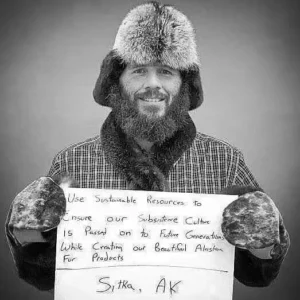
By Robert Miller | Sea Fur Sewing | Sitka, Alaska
By Robert Miller | Sea Fur Sewing | Sitka, Alaska
When people ask me what makes a real Alaska fur hat different from the ones you can buy in a store, I tell them there’s a whole lot more to it than just keeping your head warm.
Don’t get me wrong, keeping warm is important, especially living here in Alaska. But for me, there’s a story behind every hat I make. A story that starts long before I ever sit down at my sewing machine.
It starts out on the water, with the harvest, and with the traditions that have been passed down through generations of our people.
I’m Robert Miller, a Kiks.ádi Tlingit from Sitka, Alaska, and I’m the owner of Sea Fur Sewing.
I’ve spent most of my life living and working in Southeast Alaska. I’ve been on the water, worked in the woods, hunted, fished, and experienced just about every kind of weather Southeast Alaska can throw at you.
And if there’s one thing I’ve learned, it’s that having the right gear makes a big difference.
There’s a Reason Our People Used Fur
Think about it for a minute.
Our ancestors didn’t have fancy outdoor clothing stores. They didn’t have all the synthetic materials and insulated jackets we have today.
They used what was available to them.
The animals they harvested provided food, clothing, and materials needed to survive. Nothing was taken lightly, and everything had a purpose.
Sea otters have some of the thickest fur of any animal on earth. Instead of relying on a thick layer of blubber like seals and sea lions, sea otters depend on that incredibly dense fur to help keep them warm in the cold waters of Alaska.
That same natural fur can make an incredibly warm hat.
When you put on one of my sea otter fur hats, you’re wearing something made from one of nature’s most remarkable insulating materials.
And when it’s properly made and taken care of, it’s something that can last for years.
For Me, It Starts With the Harvest
One thing I want people to understand about my business is that food comes first.
When I harvest seals, the meat and other usable parts are just as important as the skin.
I believe strongly in sharing our traditional foods, especially with our elders and others who can no longer get out and harvest for themselves.
I’ve always felt that if an animal gives its life, we have a responsibility to make good use of what it provides.
That includes the fur and skins.
There is a lot of work that goes into making a hat before a needle ever touches the material.
There’s the harvest, taking care of the hide, getting it properly prepared and tanned, and then finally getting it back into my shop.
By the time I start cutting patterns and sewing, I’ve already got a lot invested in that piece of fur.
That’s something people don’t always see when they’re looking at a finished hat.
I Didn’t Just Wake Up One Day Knowing How to Sew Fur
I started Sea Fur Sewing back in 2013.
And I’ll tell you, there was a learning curve.
I had to figure out how to work with different furs, how to cut them, how to sew them, and how to make something that not only looked good but would actually hold up when somebody wore it.
I’ve broken plenty of needles and made my share of mistakes along the way.
Some things worked. Some didn’t.
But I kept at it.
Over the years, I’ve learned that every piece of fur is different. You can’t just throw it on a table, cut it out, and expect everything to turn out perfectly.
You have to pay attention to the way the fur lays, how the pieces match up, and how everything comes together.
Sometimes I’ll spend quite a bit of time just looking at a piece of fur before I ever make the first cut.
That’s part of making something by hand.
And even after all these years, I’m still learning.
Why I Like Working With Sea Otter Fur and Seal Skin
I make several different styles of handmade fur hats, but two of my favorite materials to work with are sea otter fur and seal skin.
They each have their own purpose.
Sea otter fur is extremely dense and soft. It makes a beautiful lining, and it’s also an incredible material for a full-fur hat.
Seal skin has its own unique qualities. It has a smooth outer surface and natural weather-resistant properties that make it useful for clothing.
When I combine the two, like I do with my sea otter fur and seal skin trapper hats, I get a hat that offers protection on the outside and warmth and comfort on the inside.
I also make double-sided sea otter fur trapper hats for people who want fur both inside and out.
One of the things I enjoy about this work is being able to make something for a specific person.
Somebody might want a hat for running their boat in the winter. Somebody else might want one for hunting, trapping, or just staying warm.
And then there are customers who want something beautiful they can wear on special occasions or eventually hand down to their children.
I enjoy making them all.
You can see some of my handmade hats here:
Sea Otter and Seal Skin Trapper Hat
Double-Sided Sea Otter Fur Trapper Hat
Every Hat Has a Little Piece of Me in It
This is probably the biggest difference between one of my hats and something mass-produced in a factory.
When somebody orders a hat from Sea Fur Sewing, I’m the guy making it.
I’m the one selecting the material, cutting the patterns, sitting at the sewing machine, and making sure everything comes together the way it should.
I take pride in that.
I know what it’s like to be outside in the weather. I know how miserable it can be when the wind gets blowing and the cold starts working its way through your clothing.
So when I make a hat, I want it to be something I would wear myself.
And I want the person who buys it to be proud of it.
There’s something pretty special about knowing that something I made here in my little shop in Sitka is being worn by somebody clear across the country.
Keeping Our Traditions Alive
This is the part of Sea Fur Sewing that means the most to me.
I’m a Kiks.ádi Tlingit, and I’m proud of where I come from.
Like a lot of Alaska Native people, I grew up knowing pieces of our culture but not necessarily having every traditional skill handed directly to me.
Some of those things I had to go out and learn for myself.
Fur sewing was one of them.
What started out as wanting to learn a traditional skill turned into something much bigger than I ever imagined.
Today, Sea Fur Sewing is my full-time business.
But I don’t ever want to lose sight of why I started.
I believe it’s important that our children and grandchildren understand where they come from. I want them to know that our traditional ways of hunting, fishing, gathering, and making things with our own hands still have a place in today’s world.
That doesn’t mean we have to live exactly like our ancestors did.
It means we take what they taught us, learn from it, and carry it forward.
I’ve also had the opportunity to work with young men through the Cultural Warriors program, helping teach outdoor skills, harvesting, and the responsibilities that come with providing for others.
I get a lot of satisfaction out of that work.
Because it really doesn’t do much good for me to learn all these things if I don’t help pass them along to somebody else.
Our traditions aren’t going to survive just because we talk about them. We’ve got to get out there and actually do them.
And we’ve got to bring our young people along with us.
More Than Just a Business
I’ve been fortunate to do a lot of things in my life.
I spent more than 30 years working in the forests and waters of Southeast Alaska, much of that time as a fisheries biologist with the Forest Service.
I’ve had the opportunity to travel, meet some incredible people, and experience things I never would have imagined growing up.
I’ve even had the opportunity to share parts of my life and traditional activities with people around the world through television.
But one of the things I’m most proud of is building Sea Fur Sewing into what it is today.
What started out as me trying to learn how to sew fur has grown into a business that allows me to work with my hands, provide for my family, and share a part of our culture with people who appreciate it.
I don’t take that for granted.
And I don’t ever want Sea Fur Sewing to become just another business selling products.
I want people to understand there’s a real person behind what they’re buying.
There’s a family, a community, a culture, and a whole lot of hard work behind it.
When You Buy One of My Hats
When somebody buys a genuine sea otter fur hat or seal skin trapper hat from Sea Fur Sewing, they’re getting something handmade right here in Sitka, Alaska.
Not something coming off an assembly line.
Not an imitation made to look like the real thing.
They’re getting a piece that I’ve put my own time and effort into making.
But they’re also supporting something that’s important to me.
They’re helping support a small Alaska Native-owned business and the continuation of traditional craftsmanship.
And in a way, they’re becoming part of the story too.
I appreciate every single person who has supported Sea Fur Sewing over the years.
Whether you’ve purchased something, shared one of my posts, told a friend about my business, or simply taken the time to learn what I do, it means a lot.
I’m looking forward to continuing this journey and seeing where it takes us.
And hopefully, somewhere down the road, my children and grandchildren will look at the things I’ve made and understand why this work mattered so much to me.
Because in the end, it’s about a whole lot more than making fur hats.
It’s about where we come from, taking care of what we’ve been given, and making sure the next generation has something worth carrying forward.
Gunalchéesh — Thank you.
Robert Miller
Kiks.ádi Tlingit
Owner, Sea Fur Sewing
Sitka, Alaska
Visit Sea Fur Sewing — Handmade Alaska Native Fur Clothing
From the harvest to the finished product, made with pride in Southeast Alaska.